
Imagine working for several years only to discover that your Social Security System (SSS) contributions were never properly remitted. When it’s finally time to apply for sickness benefits, maternity benefits, retirement pensions, or even a housing loan, missing contributions suddenly become a major problem.
Unfortunately, this situation happens more often than many employees realize. On the employer’s side, failing to remit SSS contributions accurately and on time can result in penalties, legal liabilities, and compliance issues.
Whether you’re a newly hired employee, a self-employed professional, an HR manager, or a business owner, understanding SSS contribution requirements is essential. Every contribution made today serves as an investment in future financial security and ensures compliance with Philippine labor laws.
In this comprehensive guide, you’ll learn everything you need to know about SSS contribution 2026, including contribution brackets, premium computations, payment methods, online verification, employer responsibilities, and how professional payroll or Employer of Record (EOR) services can simplify compliance.
What is SSS Contribution?
An SSS contribution refers to the mandatory monthly payment made to the Philippine Social Security System by employers, employees, self-employed individuals, voluntary members, overseas Filipino workers (OFWs), and household employers.
These contributions fund various social insurance programs that provide financial assistance during significant life events such as illness, disability, childbirth, unemployment, retirement, and death.
Think of your SSS contribution as a long-term financial safety net. Instead of simply paying another government obligation, you’re building eligibility for valuable benefits that may support you or your family when unexpected circumstances arise.
The amount contributed depends primarily on your Monthly Salary Credit (MSC), which determines how much both the employer and employee must contribute each month.
For employed members, contributions are shared between:
- Employer
- Employee
Employers are responsible for deducting the employee’s share from their salary and remitting both portions to the SSS within the prescribed deadlines.
Why SSS Contributions Are Important
Many employees only begin paying attention to their SSS records when they need to claim benefits. However, consistent and accurate contributions offer numerous long-term advantages.
Financial Security During Emergencies
Life is unpredictable. SSS provides financial assistance during periods when members are unable to work due to illness, disability, or involuntary unemployment.
These benefits help reduce financial stress during difficult situations.
Retirement Income
One of the biggest reasons to maintain regular contributions is retirement.
Qualified members receive monthly pensions or lump-sum benefits depending on their contribution history.
Consistent contributions throughout your working years directly affect your retirement benefits.
Maternity Benefits
Eligible female members may receive maternity benefits that replace lost income during childbirth or miscarriage.
Maintaining updated contributions helps ensure eligibility.
Sickness Benefits
Employees who become temporarily unable to work because of illness or injury may qualify for sickness benefits.
Without sufficient contributions, these claims may be denied.
Disability Benefits
Members who suffer partial or permanent disabilities may receive monthly disability pensions or lump-sum benefits depending on their contribution records.
Death and Funeral Benefits
If an SSS member passes away, qualified beneficiaries may receive:
- Monthly pensions
- Lump-sum benefits
- Funeral assistance
These benefits provide financial support to surviving family members during difficult times.
SSS Contribution Compliance with Philippine Labor Laws
Under Philippine law, registering your business and your staff with the SSS, and remitting the exact amounts on time, is a strict statutory obligation. Failing to deduct or remit these funds can lead to severe criminal liabilities, including hefty fines and imprisonment. Beyond avoiding penalties, paying contributions correctly builds trust, signals corporate legitimacy, and forms a key pillar of worker retention.
EOR Partner of Choice for Expats for 14+ Years
Need an Employer of Record (EOR) in the Philippines?
Look no further — we, at THS, handle HR tasks, payroll, and labor compliance, so you can grow your workforce globally without the hassle of setting up a local entity.
Who Needs to Pay SSS Contributions?
Several categories of members are required or encouraged to contribute to the Social Security System.
These include:
- Private-sector employees
- Employers
- Self-employed individuals
- Household employers
- Household workers (Kasambahays)
- Overseas Filipino Workers (OFWs)
- Voluntary members
- Non-working spouses (subject to eligibility)
Each membership type follows different contribution rules, payment schedules, and reporting requirements.
SSS Contribution Bracket
One of the most searched topics every year is the SSS contribution bracket.
Your contribution is not based on your exact monthly salary alone. Instead, SSS assigns your compensation to a Monthly Salary Credit (MSC) bracket.
Each bracket corresponds to:
- Total monthly contribution
- Employer share
- Employee share
- Benefit computation
Generally speaking:
- Higher Monthly Salary Credits result in higher monthly contributions.
- Higher contributions also increase potential future benefits, particularly retirement and disability pensions.
Since contribution schedules may be updated periodically, employers and members should always refer to the latest SSS contribution table applicable for SSS contribution 2026 before processing payroll or voluntary payments.
SSS Premium Contribution
Many people also search for SSS premium contribution, which simply refers to the total amount paid each month based on your assigned salary bracket.
For employed members, the premium is divided between:
- Employer contribution
- Employee contribution
For voluntary members and self-employed individuals, they shoulder the entire premium contribution themselves.
Choosing a higher salary credit, when allowed, may increase future benefit entitlements, making it an important long-term financial planning consideration.
SSS Minimum Contribution
The SSS minimum contribution depends on the lowest Monthly Salary Credit applicable to your membership category.
Minimum contributions are commonly paid by:
- Voluntary members
- Self-employed individuals with lower declared income
- Some household workers
- Members resuming contributions after periods of unemployment
While paying the minimum helps maintain active membership, consistently contributing based on your actual income generally results in better future benefits.
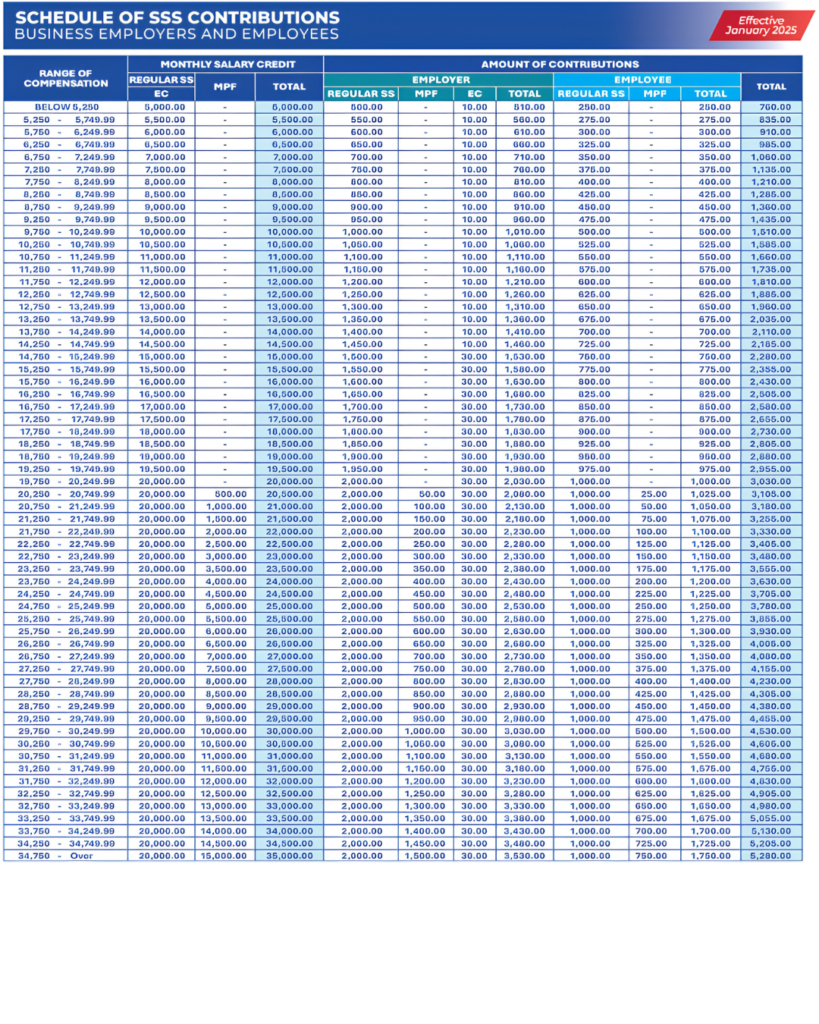
Updated 2026 SSS Contribution Table
How a Professional Employer of Record (EOR) Provider Can Help
Managing SSS contributions, payroll, and statutory compliance can be time-consuming, especially for growing businesses and foreign companies hiring in the Philippines. A professional Employer of Record (EOR) provider simplifies these responsibilities by handling payroll processing, SSS, PhilHealth, and Pag-IBIG contributions, tax withholding, employment contracts, and labor law compliance. This ensures accurate and timely remittances, reduces administrative workload, and minimizes the risk of costly penalties or compliance issues.
With an experienced EOR Philippines provider, businesses can legally hire and manage employees without establishing a local entity. By taking care of payroll administration and government-mandated obligations, an EOR allows companies to focus on business growth while ensuring full compliance with Philippine employment regulations. Whether you’re a startup, expanding enterprise, or international company, partnering with a trusted Employer of Record provides a faster, more efficient, and compliant way to build your workforce.
Final Thoughts
Understanding SSS contributions is essential for every employee, employer, self-employed individual, and voluntary member in the Philippines. More than just a mandatory government deduction, an SSS contribution serves as a financial safety net that provides protection during life’s most important moments, from sickness and maternity to disability, unemployment, retirement, and even death benefits for your loved ones.
As the SSS contribution 2026 rates and salary brackets continue to shape benefit computations, knowing how contributions are calculated, understanding the applicable SSS contribution bracket, and staying informed about your Monthly Salary Credit (MSC) can help you make better financial decisions and maximize your future benefits. For employers, proper contribution management is not only a legal obligation but also a critical component of maintaining compliance and protecting employee welfare.
Whether you’re a newly hired employee checking your first deductions or a business owner managing payroll obligations, taking the time to understand the fundamentals of SSS contributions can help you avoid costly mistakes and ensure long-term financial security.
How much is the SSS contribution in 2026?
The SSS contribution rate for 2026 remains at 15% of the Monthly Salary Credit (MSC). For employed members, the contribution is shared between the employer and employee, with the employer paying 10% and the employee paying 5%. The actual amount depends on the member’s salary bracket and assigned MSC.
How can I check my SSS contribution online?
You can check your SSS contribution online by logging into your My.SSS account through the SSS Member Portal. Once logged in, navigate to Inquiry > Contributions to view your posted contributions, Monthly Salary Credits (MSC), and contribution history.
What happens if my employer does not remit my SSS contributions?
If your employer deducts contributions from your salary but fails to remit them to SSS, they may face penalties, interest charges, and legal action. Employees should regularly monitor their contribution records and immediately raise any discrepancies with their employer or the Social Security System.
Can I continue paying SSS contributions if I am no longer employed?
Yes. If you are no longer employed, you may continue your membership as a voluntary member or self-employed member, depending on your circumstances. Continuing your contributions helps maintain your eligibility for SSS benefits and can increase your future retirement pension.
What is the minimum SSS contribution for 2026?
The minimum SSS contribution is based on the minimum Monthly Salary Credit (MSC) of ₱5,000. At the current contribution rate of 15%, the minimum total monthly contribution is ₱750. The exact amount may vary depending on the member category, such as employed, self-employed, voluntary, or OFW members.